

คู่มือเลือกใช้หน้าแปลนเหล็กและสแตนเลส (JIS, ANSI, DIN)
ให้เหมาะกับระบบท่อ
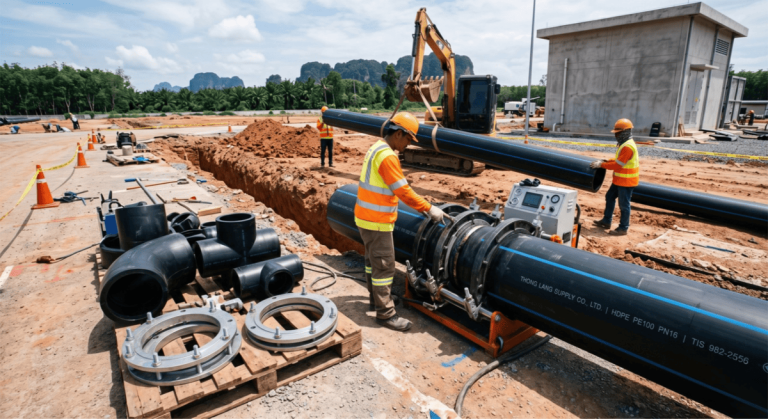
Developing reliable fluid conveyance infrastructure—whether for municipal potable water networks, extensive agricultural irrigation, or demanding industrial plants—requires materials capable of withstanding high internal pressures, aggressive chemicals, and environmental fatigue. The HDPE piping system (High-Density Polyethylene) has emerged as the definitive engineering standard, replacing conventional ductile iron, steel, and concrete conduits.
This technical guide details the specifications of HDPE pipes, fittings, and accessories, outlining resin classifications, pressure ratings (PN), advanced jointing technologies, and structural durability advantages to ensure cost efficiency, compliance, and long-term operational integrity.
1. Understanding the HDPE Piping System and Governing Standards
- High-Density Polyethylene is a semi-crystalline engineering thermoplastic characterized by an exceptionally dense molecular structure. This structure imparts remarkable tensile strength, high impact resistance, and superior ductility. HDPE pipes are easily identified by their black exterior featuring co-extruded longitudinal color stripes designating service type:
- Blue Stripe: Municipal drinking water, potable distribution networks, and building service lines.
- Orange or Yellow Stripe: Underground electrical conduit, fiber-optic cable ducting, and fuel gas distribution.
Regulatory and Manufacturing Standards
To guarantee safety and performance in engineered infrastructure, HDPE pipes and fittings must comply with rigorous international and national standards:
- TIS 982-2556 (Thai Industrial Standard): Polyethylene pipes for drinking water service.
- ISO 4427 / EN 12201: Plastics piping systems for water supply, and for drainage and sewerage under pressure.
- AWWA C901 / C906: American Water Works Association standards for polyethylene pressure pipe and tubing.
2. Resin Classification: PE 80 vs. PE 100
Selecting the appropriate HDPE piping begins with evaluating the raw polymer material grade, defined by its Minimum Required Strength (MRS)—the circumferential stress the material can endure at 20°C for 50 years.
PE 80 Resin
- Features an MRS
- Well-suited for low-to-medium pressure applications and smaller nominal pipe diameters.
- Requires a thicker pipe wall to achieve the same pressure rating as PE 100, which results in higher material weight per linear meter and a reduced internal cross-sectional flow area.
PE 100 Resin
- Features an MRS rating of 10.0 MPa.
- Represents the modern engineering benchmark for major municipal mains, trunk lines, and industrial distribution systems.
- Higher polymer density enables thinner pipe walls without sacrificing design pressure ratings.
- Maximizes hydraulic flow capacity and lowers total weight, optimizing shipping logistics and trench handling.
3. Pressure Ratings (PN) and Standard Dimension Ratios (SDR)
4. HDPE Pipes, Fittings, and Accessories: Jointing Methodologies
The structural reliability of an HDPE pipeline depends directly on jointing execution. Thermally fused connections produce a homogenous, monolithic assembly with joint integrity that matches or exceeds the parent pipe. The primary connection methods include:
1. Butt Fusion Welding
The prevailing standard for pipelines measuring 63 mm OD and larger:
- Procedure: Square the pipe ends using an electric facing tool. Place a PTFE-coated heating plate (heated to 200–220°C) between the ends until an even melt bead forms. Remove the heating plate and bring the molten ends together under hydraulic pressure, holding them until fully cooled according to standard weld matrices.
- Advantages: Fully leak-proof joint with no extra fittings required along straight runs, reducing procurement costs on long installations.
2. Electrofusion Welding
A high-precision jointing method ideal for congested urban corridors, deep trenches, and maintenance tie-ins:
- Procedure: Utilize specialized electrofusion couplers, tees, or elbows manufactured with embedded electrical resistance wire coils. Insert the prepped pipe ends into the fitting and connect an automated electrofusion control box. The unit scans the fitting barcode and energizes the coils, melting the mating surfaces uniformly.
- Advantages: Eliminates pipe movement during fusion, fits tight clearances, and minimizes operator error through automated weld parameter tracking.
3. Compression Fittings
- Primarily utilized for smaller distribution lines (20 mm to 110 mm OD) in commercial plumbing, domestic utility meters, and micro-irrigation.
- Relies on an internal elastomeric O-ring, split-ring collet, and threaded mechanical nut. No heat or specialized fusion equipment is required, allowing easy field disassembly.
4. Flange Transitions (Stub Ends & Backing Rings)
- Combines an HDPE stub end fused to the pipe end with a ductile iron or coated carbon steel backing flange ring.
- Provides a secure mechanical transition to bolt up to butterfly valves, gate valves, booster pumps, and legacy metallic piping systems.
5. Technical Comparison: HDPE Fittings by Application
|
Fitting Type |
Recommended Size Range |
Required Equipment |
Site Suitability |
Primary Advantage |
|
Butt Fusion Fittings |
63 mm – 1,200 mm |
Hydraulic butt fusion machine |
Long cross-country runs, open trenches |
Monolithic joint, lowest unit hardware cost |
|
Electrofusion Fittings |
20 mm – 630 mm |
Barcode electrofusion processor |
Confined spaces, pipe repair, tight pits |
High repeatability, no axial pipe movement |
|
Compression Fittings |
20 mm – 110 mm |
Mechanical spanner / hand tools |
Building risers, branch lines, agriculture |
Fast assembly, no power required, demountable |
|
Flange Transitions |
63 mm – 1,000 mm |
Torque wrench, hardware sets |
Plant tie-ins, valve pits, pump stations |
Direct integration with equipment and valves |
6. Engineering Advantages and Material Durability
- Exceptional Chemical and Corrosion Resistance: Polyethylene is chemically inert. It does not rust, pit, tuberculate, or support galvanic corrosion when exposed to aggressive soils, hydrogen sulfide (H_2 S), strong acids, alkalis, or high-salinity brine.
- High Ductility and Surge Damping: High flexibility allows the pipe to follow terrain contours and gentle trench curves, eliminating intermediate elbow fittings. HDPE effectively absorbs pressure surges and water hammer due to its low modulus of elasticity.
- Low Friction and Hydraulic Efficiency: A smooth bore (Hazen-Williams friction factor C=150) maintains laminar flow and resists mineral scaling or biological growth over decades. This keeps head loss low and reduces long-term pumping power consumption.
- UV Stability and 50+ Year Design Life: Formulated with 2.0% to 2.5% finely dispersed carbon black, HDPE pipe resists weathering from solar radiation and ultraviolet degradation, ensuring over 50 years of design service life.
- Biological Safety and Potable Certification: Non-toxic and heavy-metal-free, certified PE 100 resins impart no taste, odor, or color to drinking water supplies, meeting strict global health and environmental regulations.
An optimized HDPE piping installation balances hydraulic calculations, working pressures, and soil conditions with the appropriate resin grade (PE 80 or PE 100) and pressure rating (PN). Aligning these specifications with proper jointing methods—such as butt fusion for open cross-country lines and electrofusion for confined spaces—yields a leak-free, non-corrosive pipeline that provides decades of low-maintenance fluid conveyance.