


Selection Guide for Carbon Steel and Stainless Steel Flanges (JIS, ANSI, DIN) for Piping Systems
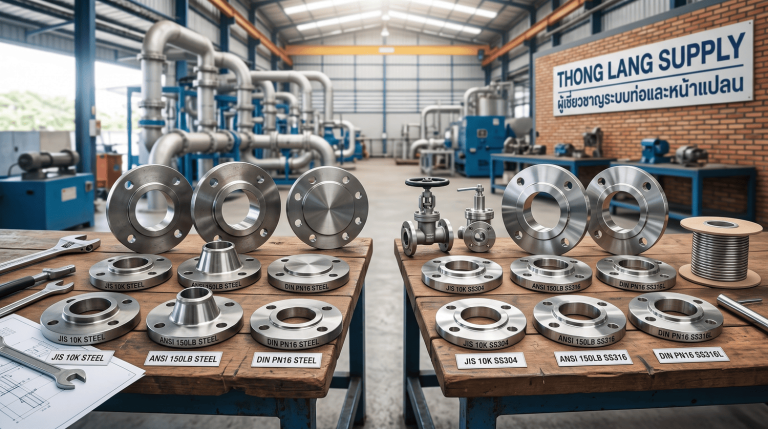
In industrial piping and general engineering, a connector just as crucial as the pipes or valves is the “flange.” If a piping system is compared to blood vessels, flanges are like the joints that reliably connect the entire system, allowing for easy disassembly and ensuring it is safe from leaks.
However, many novice technicians or contractors may have experienced problems such as purchasing flanges of the wrong size, being unable to fit them to existing valves, or encountering rust and leaks shortly after use. The main cause stems from a lack of understanding regarding materials and pressure standards. This article from Thonglang Supply will guide you through an in-depth understanding of piping systems and flanges in simple terms, enabling you to choose carbon steel and stainless steel flanges accurately, safely, and most cost-effectively.
1. What is a flange and what is its function in a piping system?
A flange is a circular or other-shaped metal plate with a center hole allowing liquid or gas to flow through, surrounded by bolt holes for securing connections between pipe-to-pipe, pipe-to-valve, pipe-to-pump, or attaching to pressure vessels.
Why use flanges instead of direct welding?
● Easy disassembly and maintenance: When cleaning, replacing valves, or servicing pumps, simply removing the bolts allows for immediate component removal.
● High pressure resistance: Flanged connections handle pressure and vibration better than standard threaded connections.
● Effective force distribution: Helps reduce stress generated at the pipe connection points.
2. Decoding Flange Standards: How do JIS, ANSI, and DIN differ?
One of the most common points of confusion for technicians and buyers is regarding standards and pressure ratings. Because flanges manufactured in different regions have different specifications and bolt hole spacings, selecting the wrong standard will make it impossible to bolt them together.
The 3 main standards commonly used in Thailand are as follows:
1. JIS Standard (Japanese Industrial Standards)
● Key Highlight: A Japanese international standard, most widely used in Thailand and across Asia.
● Pressure Symbol: Uses the letter “K”, such as 10K, 10K (Slip-On), and 20K.
● Meaning: The “K” number indicates the approximate pressure rating. For example, JIS 10K means it can withstand a maximum pressure of approximately 10 kilograms-force per square centimeter (10 kgf/cm²) or around 10 bar.
● Applications: General water systems, high-rise buildings, fire protection systems, and general industrial plants.
2. ANSI / ASME Standard (American National Standards Institute)
● Key Highlight: A United States standard, commonly used in the petrochemical, oil, natural gas industries, and for machinery imported from America.
● Pressure Symbol: Uses “Class” or “LB”, such as Class 150 (150LB) and Class 300 (300LB).
● Meaning: The pound number (LB) does not refer directly to PSI pressure, but represents a Pressure Rating Class. For instance, ANSI 150LB can withstand slightly higher pressure than JIS 10K at room temperature.
● Applications: Oil pipes, gas pipes, high-pressure steam pipes, and heavy chemical applications.
3. DIN / EN Standard (Deutsches Institut für Normung)
● Key Highlight: German and European standard, commonly used in European machinery, food processing plants, and wastewater treatment systems.
● Pressure Symbol: Uses “PN” (Pressure Nominal), such as PN10, PN16, and PN40.
● Meaning: The PN number directly indicates the working pressure in bar; for example, PN16 means it can handle a pressure of 16 bar.
● Applications: Machinery imported from Europe and high-precision chemical piping systems.
Comparison Table of Popular Flange Standards
| Standard | Country / Region | Common Pressure Symbols | Approximate Equivalent Pressure Rating | Common Applications |
| JIS | Japan / Asia | JIS 5K, 10K, 20K | 10K approx. 10 Bar | Water supply systems, high-rise buildings, general factories |
| ANSI | United States | 150LB, 300LB, 600LB | 150LB approx. 16-19 Bar (depending on temperature) | Petrochemical, oil, natural gas |
| DIN | Europe | PN6, PN10, PN16, PN40 | PN16 = 16 Bar | European machinery, chemical plants, food industry |
3. Deep Dive into Material Selection: Carbon Steel Flanges vs. Stainless Steel Flanges
Material selection is the heart of piping system and flange design because it directly impacts lifespan, corrosion issues, and safety.
[Popular Carbon Steel and Stainless Steel Types]
├── 1. Carbon Steel
│ └── Grade SS400 / A105 -> Suitable for water, air, and general oil
└── 2. Stainless Steel
├── SUS304 -> Rust-resistant, water-resistant, resistant to mild chemicals (Food/Drinking water applications)
└── SUS316 / 316L -> Resistant to acids, alkalis, concentrated chemicals, and marine salt spray
Carbon Steel Flange
Carbon steel flanges are manufactured from ductile iron or carbon steel (such as grades SS400, A105). They are the most popular type of flange due to their economical price and high strength.
● Key Highlights:
○ Cost-effective with excellent resistance to impacts and pressure.
○ Superior high-temperature resistance.
○ Easy to weld securely to steel pipes.
● Limitations: Prone to rust if exposed to moisture, water, or chemicals; therefore, they require anti-rust painting, galvanization, or powder coating.
● Suitable Applications: Chilled water pipe systems, compressed air lines, fire protection lines, fuel lines, and general steam lines.
Stainless Steel Flange
Stainless steel flanges are manufactured from high-quality stainless steel containing chromium and nickel, which help form a protective surface film preventing easy rust formation. Commonly used types include SUS304 and SUS316/316L.
● Key Highlights:
○ High corrosion and rust resistance: Long service life even when exposed to moisture or chemicals.
○ Clean and Hygienic: No peeling, leaving no rust stains to contaminate fluids.
○ Chemical and heat resistance: Can handle acids, alkalis, and temperature fluctuations well.
● In-depth Stainless Steel Grades:
○ SUS304: Standard grade with good rust resistance. Suitable for drinking water, food, beverages, and diluted chemicals.
○ SUS316 / 316L: Formulated with added Molybdenum, providing excellent resistance to salt spray, seawater, concentrated acids, and chlorine.
● Suitable Applications: Food and pharmaceutical manufacturing plants, chemical plants, wastewater treatment systems, coastal/offshore applications, and piping systems requiring high levels of hygiene.
4. Selection Factors: Heat Resistance, Chemical Resistance, and Environment
To make the most effective material and standard selections for your flange, consider these 3 key factors:
1) Fluid Medium
● For clean water, compressed air, oil: Carbon steel flanges can be selected to save budget.
● For drinking water, food, milk, pharmaceuticals: SUS304 stainless steel flanges should be used for cleanliness.
● For concentrated acids, corrosive chemicals, seawater: SUS316/316L stainless steel flanges must be chosen.
2) Working Temperature & Pressure**
● Pressure: Select a pressure rating (JIS 10K, ANSI 150LB, DIN PN16) at least 20-30% higher than the maximum system pressure to accommodate potential water hammer phenomena.
● Temperature: If the system operates at very high temperatures (such as steam pipes exceeding 200°C), the allowable pressure rating of the flange decreases proportionally. A higher Class standard must be selected, along with a compatible heat-resistant gasket.
3) External Environment
● Indoor / dry building installation: Carbon steel flanges with anti-rust coating are sufficient.
● Outdoor installation / exposure to rain, acidic gas environments, or coastal areas:** Stainless steel flanges should be selected to prevent external pitting corrosion and rust.
5. Summary: Techniques for Cost-Effective and Safe Flange Selection
Selecting a flange that fits a piping system involves more than just checking nominal size in inches; all components must be thoroughly verified:
1. **Check the original equipment standard:** Verify what standard the existing valves or machinery use (JIS, ANSI, or DIN) to select matching flanges.
2. **Choose the right material for the job:** Carbon steel flanges are suitable for general, budget-focused applications, while stainless steel flanges are suited for corrosion-resistant and hygienic applications.
3. **Don’t forget gaskets and bolts:** Always select gasket materials (Rubber, EPDM, Teflon, Graphite) and flange bolt grades that match the chemical and heat resistance requirements of the flange.
If you are looking for high-quality carbon steel or stainless steel flanges that meet international standards across all pressure ratings (JIS, ANSI, DIN), supported by an expert team ready to provide advice, you can view products and inquire further at [www.thonglangsupply.com](https://www.google.com/search?q=https%3A%2F%2Fwww.thonglangsupply.com) — the center for industrial piping systems, valves, and flanges trusted by technicians and contractors.